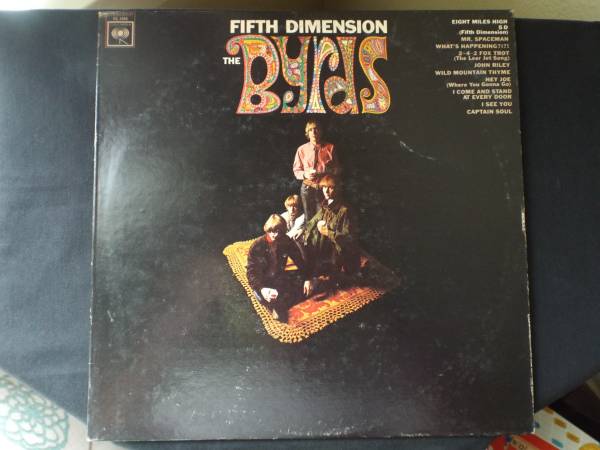
$ LP's one money $40
Fifth Dimension, Younger than Yesterday, Mr. Tambourine Man, Turn Turn Turn.
Fifth Dimension is the third studio album by the American rock band the Byrds, released on July 18, 1966, by Columbia Records. Most of the album was recorded following the February 1966 departure of the band's principal songwriter Gene Clark in an attempt to compensate for Clark's absence, guitarists Jim McGuinn and David Crosby increased their songwriting output. In spite of this, the loss of Clark resulted in an album with four cover versions and an instrumental, which critics have described as "wildly uneven" and "awkward and scattered". However, it was the first Byrds album not to include any songs written by Bob Dylan, whose material had previously been a mainstay of the band's repertoire.
Younger Than Yesterday is the fourth studio album by the American rock band the Byrds, released on February 6, 1967, by Columbia Records. It saw the band continuing to integrate elements of psychedelia and jazz into their music, a process they had begun on their previous album, Fifth Dimension. In addition, the album captured the band and record producer Gary Usher experimenting with new musical textures, including brass instruments, reverse tape effects and an electronic oscillator
Mr. Tambourine Man is the debut studio album by the American rock band the Byrds, released on June 21, 1965, by Columbia Records. The album is characterized by the Byrds' signature sound of Jim McGuinn's 12-string Rickenbacker guitar and the band's harmonies. The material on the album consists of cover versions of folk songs, primarily composed by Bob Dylan, and originals written or co-written by singer Gene Clark. Along with the Dylan-penned single of the same name, Mr. Tambourine Man established the band as an internationally successful act and is widely regarded by critics as representing the first effective American challenge to the chart dominance of the Beatles and other British Invasion bands during the mid-1960s
"Turn! Turn! Turn!", also known as or subtitled "To Everything There Is a Season", is a song written by Pete Seeger in 1959. The lyrics – except for the title, which is repeated throughout the song, and the final two lines – consist of the first eight verses of the third chapter of the biblical Book of Ecclesiastes. The song was originally released in 1962 as "To Everything There Is a Season" on the folk group the Limeliters' album Folk Matinee,